Skip to content

Seawalls

Seawall Repair

Most seawall repairs that fail were the right repair applied to the wrong diagnosis. Finding the cause is most of the job.

We get called to a lot of seawalls that have already been repaired once. Usually the work itself was done competently. What went wrong was the diagnosis — somebody treated the symptom that was visible instead of the mechanism producing it.

Diagnose first

A seawall has a small number of failure mechanisms, and each one has a different repair. Getting this right is the difference between a repair that lasts and a repair you do again in three years.

Soil loss through the wall

What you see: depressions or soft spots in the lawn, settled pavers, a tilting patio slab, water weeping through joints on a falling tide. What is happening: water moving through the wall on the tide is carrying fine soil out with it. The repair: chemical grout injection to seal the path, then void filling and soil stabilization to rebuild the ground. In that order.

Chloride attack on the concrete

What you see: rust staining, cracking in a regular pattern, flaking, exposed steel. What is happening: chlorides have reached the reinforcement, it is corroding, and corrosion products are breaking the concrete apart from inside. The repair: concrete cap and wall repair.

Tieback and anchor failure

What you see: the top of the wall leaning waterward, a cap line that is no longer straight when you sight along it. What is happening: the elements resisting horizontal soil load have corroded or lost their grip. The repair: new tiebacks and deadman anchors — or, where rotation is significant, replacement.

Toe scour

What you see: often nothing from the top. At low water, exposed pile below the expected mudline or a scoured trench at the base. What is happening: wave energy reflecting off the wall is digging out its own foundation. The repair: toe protection, and addressing any embedment that has already been lost.

Overtopping damage

What you see: erosion behind the wall, especially after storms. What is happening: water going over the wall is eroding from the land side. The repair: addressing the ground behind the wall, and sometimes cap elevation — see storm damage repair.

Pile deterioration

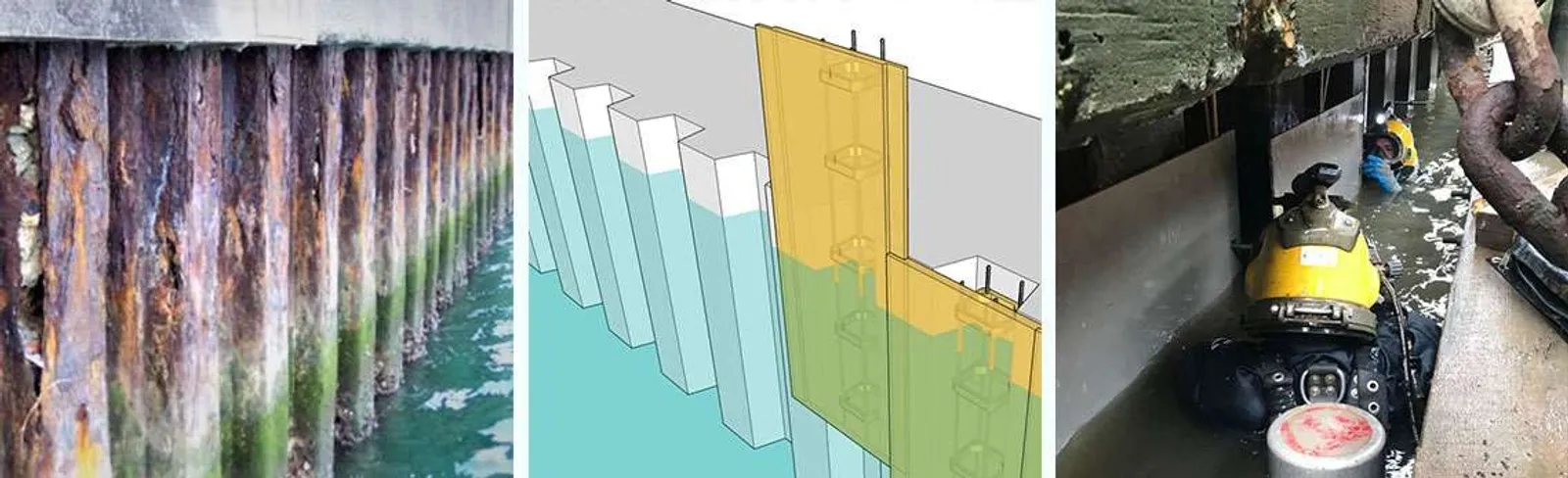
What you see: at low water, section loss, borer damage in timber, spalling on concrete piles. The repair: pile jacketing and restoration.

Why the order matters

The most common expensive mistake on a seawall is filling voids without sealing the leak. The new material becomes the next thing the tide removes, and the owner pays for the same ground twice.

The second most common is patching spalled concrete over steel that is still corroding. The patch traps the process, the corrosion continues underneath, and in a couple of years the patch fails and takes more concrete with it.

Sequence is part of the repair, not an afterthought.

What an assessment covers

A marine inspection looks at the things that actually determine the wall’s future — most of which are not visible from the top:

  • Line and plumb of the wall along its length
  • Cap condition, including sounding for debonded areas
  • Joint condition and evidence of flow
  • Extent of voids behind the wall
  • Tieback and anchor condition
  • Pile and embedment condition at and below the waterline
  • Toe scour
  • Drainage behind the wall

You get a written scope that separates what has to be done now from what can be scheduled — and, where it applies, the recommendation that the wall has reached the end and repair money would be wasted.

Call (904) 327-3931 or request a free estimate.

Frequently asked questions

How do I know if my seawall needs repair?
The useful signs are often not on the wall. Depressions or soft spots in the lawn near the water, settled pavers, a patio that has started to tilt, water weeping through joints on a falling tide, rust staining on the cap, or a change in the line of the wall when you sight along it. A wall that looks perfect can be actively exporting your yard.
Can a leaning seawall be straightened?
Walls that have rotated slightly can sometimes be re-anchored with new tiebacks and deadmen, which stops further movement — it does not generally restore the original line. Significant rotation usually means the embedment has been compromised too, and at that point replacement is the better value. The extent of movement and the condition below the waterline decide it.
How long does seawall repair take?
Injection and void filling are typically measured in days. Cap replacement and tieback work take longer because of excavation, forming and curing. Any repair requiring a permit inherits the agency review timeline, which is the least predictable part.
Should I repair or replace?
Repair if the structural elements — piles, embedment, tiebacks — are sound and the problem is leakage, soil loss or surface deterioration. Replace if those elements are gone. The replacement page covers where the line sits, and an inspection is what places your wall on one side of it.

Last reviewed October 2026 by Barefoot Marine Construction. Permit requirements and agency rules change — confirm current requirements with the reviewing agency before you plan work.

What customers say about this work

Unedited reviews from our Google Business Profile, where all 22 can be read in full.

Read them on Google
  • When we found a broken bulkhead tieback rod, we were relieved to discover Barefoot Marine, a trusted name in marine construction and bulkhead repair. Rick quickly visited our property and recommended installing new stainless steel tieback rods alongside the old ones, paired with an updated anchor system. This smart, cost-effective solution was less invasive and preserved our seawall’s integrity, adding years to its lifespan. Despite their busy schedule with larger marine projects, Rick kindly worked our bulkhead repair into their timeline. The team’s professionalism, quick response, and solid workmanship shone through, delivering an affordable fix that enhanced the look of our waterfront property. We’re grateful for Barefoot Marine’s reliable service and highly recommend them for seawall repairs, tieback rod replacements, or any marine construction needs. Their quality work and customer care make them a top choice!

    John DeSalvo

    a year ago Google review

  • I was in need of a seawall in my backyard to stop the erosion into the retention pond. I did my research before hiring a company, and I am so happy that I selected Rick Powell and his team at Barefoot Marine. They kept me informed at each phase, and at the end, I was 100% satisfied with the quality of work, as well as the value delivered. My backyard is now the envy of the neighborhood. I highly recommend Rick and his team.

    Positive: Responsiveness, Quality, Professionalism, Value

    Andrew Bonderud

    3 years ago Google review

  • The owner came out personally to address our concerns after speaking on the phone for an erosion issue. He dropped everything to inspect our property and promptly submitted his report. We selected his proposal and have never regretted it. Our bulkhead retaining wall is beautiful and strong and is completely protecting our pool and house. Love these guys!

    Robert Lunsford

    5 years ago Google review

Get a free estimate on your project

Send us a few photos and what you're seeing, and we'll tell you what it needs — repair, replacement, or just monitoring.

Certified General Contractor #1533461 · Workers' Comp + USL&H Insured · Serving Northeast Florida since 2009