Skip to content

Services

Erosion Control and Shoreline Stabilization

A wall is one answer to erosion, not the only one. Sometimes it is not even the best one for the shoreline you have.

Erosion is a process, and processes have causes. The most common expensive mistake on a Northeast Florida shoreline is treating the visible symptom — the bank that is retreating — without working out what is actually driving it.

Find the cause first

Wave and wake energy. Fetch, prevailing wind, and boat wake. The usual suspect, and the one that points towards a hard structure.

Tidal and current action. Water movement along the shoreline, which can concentrate at particular points depending on shape and what is upstream.

Upland drainage. Frequently overlooked and frequently significant. Stormwater discharging over the bank, downspouts directed at the shoreline, irrigation saturating the soil, or grade that sends runoff to the water’s edge. This one is often the cheapest to fix and is sometimes most of the problem.

Loss of vegetation. Root systems hold soil. Removing shoreline vegetation for a view regularly accelerates erosion at the same property.

A failing structure next door. Water exploits the weakest point along a shoreline, and a failing wall on an adjoining property can scour at the junction and start taking your soil.

A failing structure of your own. Soil leaving through your own bulkhead or seawall looks like erosion from the land side. It is not — it is a wall problem with a different repair.

If the cause is not identified, the intervention is a guess.

Approaches

Hard stabilization

Seawalls and bulkheads. The right answer where exposure is high, where you are losing ground quickly, where structures sit close to the edge, or where the property needs a defined and permanent edge. Most effective and most expensive, with the trade-off that vertical structures reflect wave energy and must be designed with toe protection to avoid undermining themselves.
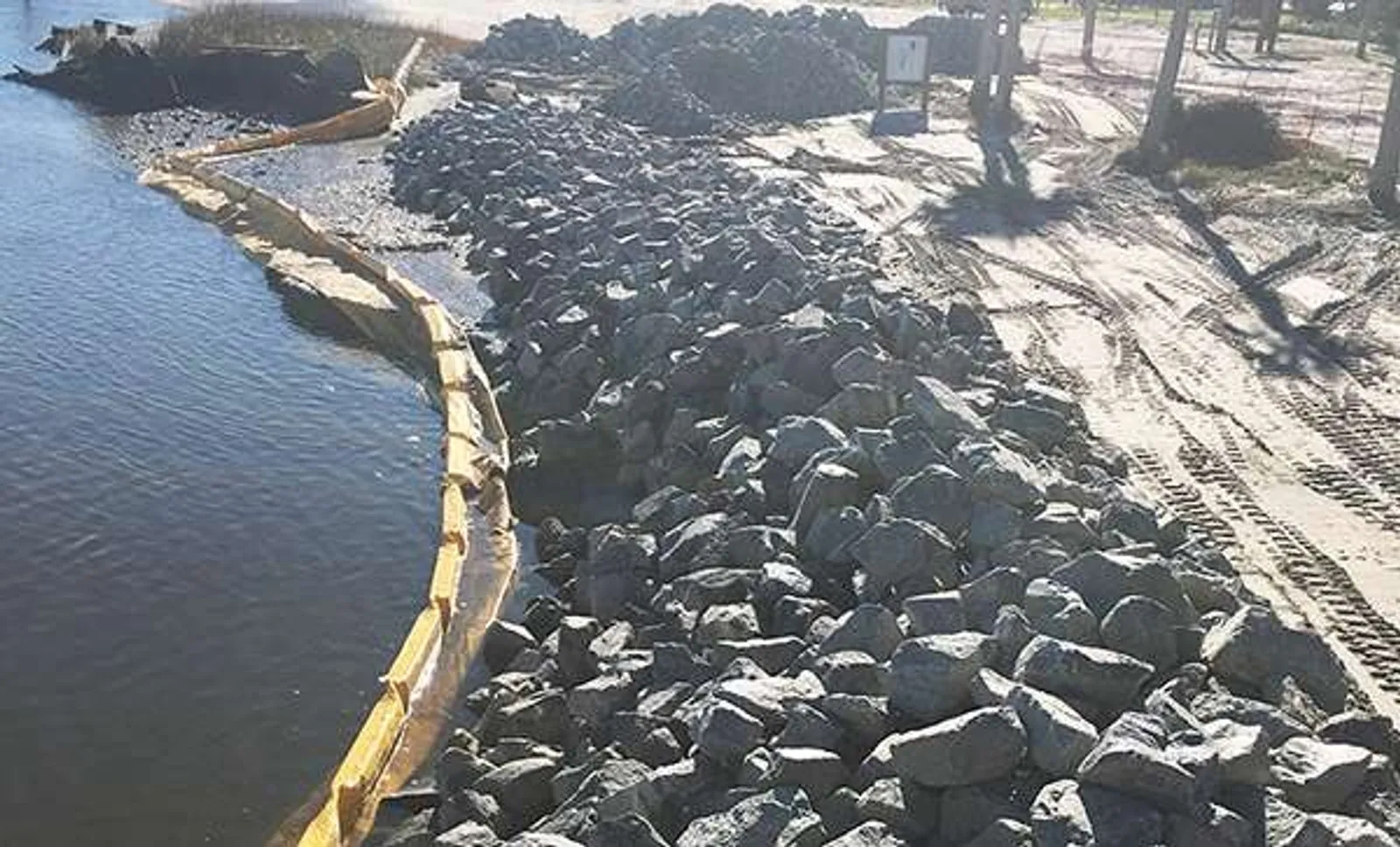
Armour stone riprap placed along a curving shoreline for erosion control, with a silt boom floating in the water alongside
Riprap placed along a curving shoreline, with a silt boom in the water during the work. A revetment like this absorbs wave energy rather than reflecting it, which is why it does not scour its own toe the way a vertical wall does.

Softer approaches

Vegetative stabilization and similar methods using plantings and natural materials to hold the bank. Lower cost, and on lower-energy shoreline with room to work they can perform well. Suitability depends on exposure, substrate, depth and the site, and they are not a substitute for a wall on high-energy shoreline. Permitting has its own requirements.

Hybrid approaches

A structural element providing protection with vegetative stabilization behind or around it. Frequently the practical answer on shoreline that is neither high-energy nor benign.

Upland measures

Drainage correction, regrading, redirecting stormwater, and managing runoff before it reaches the bank. Often the cheapest intervention available and sometimes the one that matters most — particularly where the erosion is being fed from your own property.

Shore stabilization plans

A documented assessment of what is happening at your shoreline and what to do about it. This gives you something to act on, to permit against, and to compare bids with — rather than a collection of opinions from whoever happened to be out.

What it covers: the condition of your shoreline and any existing structure, what is driving the erosion, the approaches available for your site, and what is involved in each.

Where soil has already been lost

If the ground behind a wall has been washing out, that is a different repair from shoreline erosion and it needs void filling and soil stabilization — plus sealing the leak path through the wall, or the new fill goes the same way as the old.

Permitting

Shoreline work in Northeast Florida can involve FDEP, the U.S. Army Corps of Engineers, the St. Johns River Water Management District and local authorities. Different approaches carry different requirements. Rules change — confirm current requirements with the reviewing agency. We handle permitting on the projects we build.

Call (904) 327-3931 or request a free estimate.

Frequently asked questions

Do I need a seawall or will something else work?
It depends on exposure, how much ground you are losing and how fast, what is behind the shoreline, and what the site will support. High exposure with structures close to the edge generally points to a hard structure. Lower-energy shoreline with room to work can often be stabilized with softer approaches that cost less and hold the bank just as well. We will tell you which case you are in.
What is a shore stabilization plan?
A documented assessment of what is causing erosion at your property and what to do about it, with the approach set out so it can be acted on, permitted, and used to compare bids. It matters because erosion has causes — and treating the visible symptom without identifying the cause is how people pay twice.
Can erosion be stopped without building anything?
Sometimes the most effective intervention is upland: fixing drainage that is discharging over the bank, changing where stormwater goes, or adjusting grade. Water arriving at the shoreline from your own property is a surprisingly common contributor, and it is usually the cheapest thing to fix.
Does living shoreline work in Northeast Florida?
Vegetative and hybrid approaches are used in parts of Florida, and suitability depends heavily on exposure, substrate, water depth and the specific site — they are not a universal substitute for a wall on high-energy shoreline. Permitting for these approaches has its own requirements. Confirm current requirements with the reviewing agency, and treat anyone who recommends one approach for every property with caution.

Last reviewed October 2026 by Barefoot Marine Construction. Permit requirements and agency rules change — confirm current requirements with the reviewing agency before you plan work.

What customers say about this work

Unedited reviews from our Google Business Profile, where all 22 can be read in full.

Read them on Google
  • When we found a broken bulkhead tieback rod, we were relieved to discover Barefoot Marine, a trusted name in marine construction and bulkhead repair. Rick quickly visited our property and recommended installing new stainless steel tieback rods alongside the old ones, paired with an updated anchor system. This smart, cost-effective solution was less invasive and preserved our seawall’s integrity, adding years to its lifespan. Despite their busy schedule with larger marine projects, Rick kindly worked our bulkhead repair into their timeline. The team’s professionalism, quick response, and solid workmanship shone through, delivering an affordable fix that enhanced the look of our waterfront property. We’re grateful for Barefoot Marine’s reliable service and highly recommend them for seawall repairs, tieback rod replacements, or any marine construction needs. Their quality work and customer care make them a top choice!

    John DeSalvo

    a year ago Google review

  • Lifesaver. Barefoot docks stepped up to the plate. At at time when so very many contractors don't answer their phone or say they will help but don't show up; this company showed up and did the job. We were under contract and in a bind with a damaged floating dock. Tom was out the same day I called. He assessed the situation and was able to formulate a schedule for remediation that fit our limited time frame. The work was completed beautifully, the house closed. If you need work done, this is the group you want to call.

    Cathy Holman

    5 years ago Google review

  • Rick and his team are extremely knowledgeable, experienced and very easy to work with. The repair/replacement of our community bulkheads look great and will last for years to come. Highly recommend.

    Jimmy Semrau

    3 years ago Google review

Get a free estimate on your project

Send us a few photos and what you're seeing, and we'll tell you what it needs — repair, replacement, or just monitoring.

Certified General Contractor #1533461 · Workers' Comp + USL&H Insured · Serving Northeast Florida since 2009