Skip to content

Jacksonville Beach · Duval County, Florida

Dock Construction in Jacksonville Beach

Docks designed around Jacksonville Beach's depth, tidal range and permitting picture, and the boat you actually own.

  • Atlantic Ocean
  • Intracoastal Waterway
  • residential canals

Barefoot Marine Construction builds and repairs the structures that hold Jacksonville Beach's waterfront in place. We have worked Duval County since 2009 — Certified General Contractor #1533461, carrying Workers' Compensation and USL&H coverage — the federally required cover for maritime work that falls outside state workers' compensation, and the one that actually applies to crews working over water.

This page is about dock construction specifically in Jacksonville Beach, on the Atlantic Ocean. The engineering here is not the same as it is five miles away, and an estimate written without knowing which water your property faces is a guess.

Jacksonville Beach at the water's edge

Where your dock can go, how long it has to be and what it will cost are all decided by this stretch of water long before anyone draws anything.

Jacksonville Beach spans from the Atlantic west to the Intracoastal, which means two completely different marine construction environments inside one city. The ocean-side and ICW-side properties have essentially nothing in common structurally or in regulatory terms.

Ocean-side frontage is dune and beach system. ICW-side frontage is armoured waterway and canal edge, and that is where conventional bulkhead, seawall and dock work happens. The canal communities on the western side are the practical heart of the marine construction market here.

What the water does here

On the ICW side, boat wake is the dominant load, with a significant tidal range driving substantial exchange through the canals. Ocean-side exposure is a different category entirely, governed by coastal processes rather than by anything a bulkhead addresses.

Full salt exposure. Hardware, fasteners and embedded reinforcement all corrode faster here than on the fresher inland reaches, so specification is a service-life decision rather than a detail. Tidal range is significant. That matters twice over: it drives a large volume of water in and out through any opening in a wall, and it makes a fixed-only dock awkward to board at the bottom of the tide.

Barrier sands with organic layers where marsh was filled during development. Canal-side properties typically retain dredge spoil from the original cutting. For a dock it decides pile length and penetration, deck elevation, and whether a floating section earns its place.

Common shoreline problems in Jacksonville Beach

A dock shares the shoreline with whatever wall is there, so these matter even when the job is purely a dock — the shore-end tie-in is where the two structures meet.

  • Soil loss through joints driven by a substantial tidal range
  • Wake-driven scour on ICW-facing frontage
  • Settlement of fill and dredge spoil behind ageing canal walls
  • Full salt exposure accelerating corrosion of hardware and reinforcement
  • Overtopping on lower frontage during elevated water events

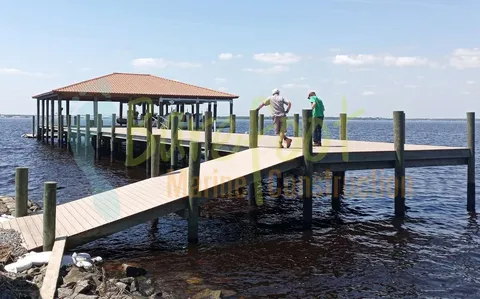
Building a dock in Jacksonville Beach

The biggest variable in any Jacksonville Beach dock estimate is how far out you have to go to reach water deep enough to float your boat at low tide. Everything else is smaller than that, and it is why two neighbouring lots can get very different numbers.

Tidal range is significant. That matters twice over: it drives a large volume of water in and out through any opening in a wall, and it makes a fixed-only dock awkward to board at the bottom of the tide.

  • Significant tidal range affecting deck elevation and boarding
  • Confined canal widths limiting slip layout and manoeuvring
  • Wake loading from Intracoastal traffic on the exposed frontage
  • Full salt exposure making hardware specification a service-life decision

What we establish before drawing anything

A good dock is a solved problem rather than a product, and the solving happens before material is ordered.

  • How you actually use the water — fishing, boarding, sitting, or a vessel on a lift
  • The boat you own now and the one you might own next, since draft sets how far out you need to go
  • Where usable depth actually is on your Atlantic Ocean frontage at low water
  • Tidal range, which decides deck elevation and whether a floating section earns its place
  • What the permits will allow, because there is no value in designing something that cannot be built

Piles, framing and hardware

Piles are the expensive component and the one living in the worst conditions. They get driven to the penetration the loads and soils require, and on this frontage that is decided by how deep competent bearing actually sits — which is why we establish it rather than assume it.

Full salt exposure. Hardware, fasteners and embedded reinforcement all corrode faster here than on the fresher inland reaches, so specification is a service-life decision rather than a detail. In practice that means fasteners and connections are where a dock's service life is decided, not the decking you look at. It is also the part that is invisible in a finished photograph, which is exactly why it is worth asking every bidder about. More on how we design custom docks.

What goes on a Jacksonville Beach dock

A dock is a platform, and on frontage as exposed as Jacksonville Beach's the things you put on it are the things the weather gets hold of first. Each of these is its own structural decision here, not an accessory.

All four are cheaper and better resolved at design stage than bolted on later, because the structure and fixings can go where they are needed instead of being worked around:

  • Handrails and railings — single rail, double rail or a full guard. Under full salt exposure here, the fixings are what decide how long a rail lasts.
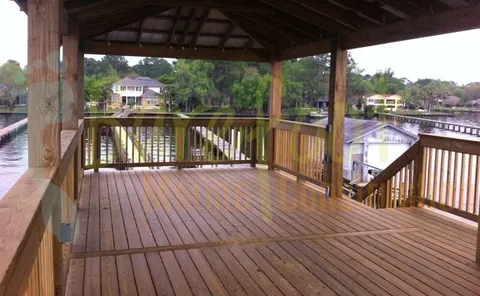
  • Gazebos and covered structures — shade is what makes a dock usable in July, but a roof over water is a sail. On exposed Jacksonville Beach frontage the uplift case is the governing one.
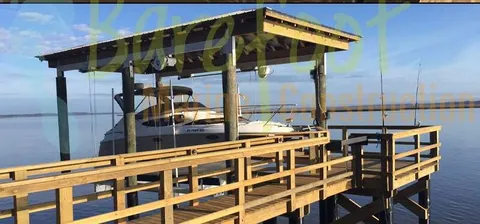
  • Boathouses — the largest covered structure most owners build. The piles decide whether it can go on an existing dock.
  • Custom decks — at the landward end, where barrier sands with organic layers where marsh was filled during development. Canal-side properties typically retain dredge spoil from the original cutting is what the footings have to deal with.

Docks and walls go together

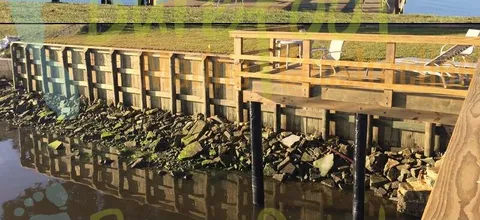
Most docks tie into a bulkhead or seawall at the shore end, and that junction is a detail that either gets done well or becomes a problem. If both structures need work, doing them in one project is almost always cheaper than two — one mobilisation, one permit process, one disruption.

It is worth asking about even if you were only thinking about the dock.

Bulkhead concerns in Jacksonville Beach

A dock shares its shore end with whatever is retaining the ground behind it. ICW and canal-side bulkheads in Jacksonville Beach retain fill against water with a large daily tidal swing, which pumps material out through any open joint efficiently. Full detail: bulkhead construction in Jacksonville Beach and bulkhead repair.

Seawall concerns in Jacksonville Beach

The wall your dock ties into is doing its own job, and how exposed it is changes what that job involves. Direct ICW frontage warrants seawall-grade specification with toe protection given sustained wake. Full detail: seawall construction in Jacksonville Beach and seawall repair.

Bulkhead and seawall get used interchangeably across Northeast Florida and we answer to both. The distinction that matters is which force governs the design — soil pressure or wave energy. We explain it properly here.

What we would recommend in Jacksonville Beach

Putting that together for a dock on this frontage:

Establish which frontage is in question before anything else — ocean, ICW or canal, because they are three different problems. Canal and ICW work follows the pattern of this whole coastal belt: joint detailing, drainage, and salt-rated hardware.

Generally workable land access on the western canal and ICW properties. Lots are compact with hardscape close to the water on many.

Permit considerations for dock construction in Jacksonville Beach

Dock permitting in Northeast Florida typically involves several reviewing agencies at once, and length, footprint and configuration are all subject to review. There is no value in designing something that cannot be approved.

Coastal construction considerations apply on the ocean side; ICW navigation review on the west. These are genuinely different review paths and the frontage determines which applies.

Requirements are revised periodically. Treat this as orientation and confirm current requirements with each reviewing agency before planning work. We handle permitting on the projects we build, and agency review is normally the longest item in the schedule.

Filter the full gallery by neighborhood, county and project type.

View all projects

Barefoot Marine's own job photography from across Northeast Florida.

Jacksonville Beach dock construction questions

How much does a bulkhead cost in Jacksonville Beach?
If you are pricing a dock alongside the wall, there is no honest per-foot figure for Jacksonville Beach, because the variables that move the number are site-specific. The ones that matter most here: retained height, the soils (barrier sands with organic layers where marsh was filled during development. Canal-side properties typically retain dredge spoil from the original cutting), whether a driveway, pool deck or structure is adding surcharge behind the wall, and access. Generally workable land access on the western canal and ICW properties. Lots are compact with hardscape close to the water on many. If you are pricing a dock and a wall together, doing both in one mobilisation is normally cheaper than two separate projects. Our estimates are free and written against your actual frontage.
How much does a seawall cost in Jacksonville Beach?
If you are pricing a dock alongside the wall, a seawall generally costs more than a bulkhead of the same length on the same site, because it carries work the bulkhead does not: toe protection sized for the exposure, deeper embedment with a scour allowance, and a heavier section for wave loading. On Jacksonville Beach frontage, genuinely exposed water that puts real energy into anything built on it, which is what drives that difference. Demolition of an existing wall and permitting are the other two line items worth stated explicitly rather than discovered later.
How long do seawalls last in Florida?
There is no single number — drainage, toe protection and tieback corrosion decide it far more than the material does. In Jacksonville Beach, full salt exposure accelerates corrosion of hardware and embedded reinforcement, which shortens the clock for any given specification. The full answer is here.
Do I need permits for a dock in Jacksonville Beach?
If you are pricing a dock alongside the wall, assume yes, and often from more than one agency. Coastal construction considerations apply on the ocean side; ICW navigation review on the west. These are genuinely different review paths and the frontage determines which applies. Depending on your site and scope that can involve FDEP, the U.S. Army Corps of Engineers, the St. Johns River Water Management District, and your county or municipal building department. Requirements are revised periodically — confirm current requirements with the reviewing agency. Our dock permits page explains who reviews what, and we handle permitting on the projects we build.
Can a seawall be repaired?
Usually — repair is a fraction of replacement when the piles, embedment and tiebacks are still sound. What that looks like in Jacksonville Beach.
What causes bulkhead failure?
Soil loss through joints, tieback corrosion, toe scour, and chloride attack on the cap — usually several at once. How that plays out in Jacksonville Beach.
What is the best bulkhead material?
No single best — for most Jacksonville Beach frontage, tied-back vinyl is the starting point, with concrete where surcharge load is real. Material choice for Jacksonville Beach.
What is the best seawall material?
Whatever the material, the section has to suit wave loading and the toe has to be protected — neither concrete nor vinyl resists scour on its own. What suits Jacksonville Beach.

Nearby waterfront communities

We work the whole of this stretch. Conditions change between these communities — sometimes a lot.

Last reviewed November 2026 by Barefoot Marine Construction. Permit requirements and agency rules change — confirm current requirements with the reviewing agency before planning work.

Dock Construction in Jacksonville Beach — free estimate

We work Duval County waterfront from our base in Jacksonville. Tell us what you are seeing and we will tell you what it needs.

Certified General Contractor #1533461 · Workers' Comp + USL&H Insured · Serving Northeast Florida since 2009