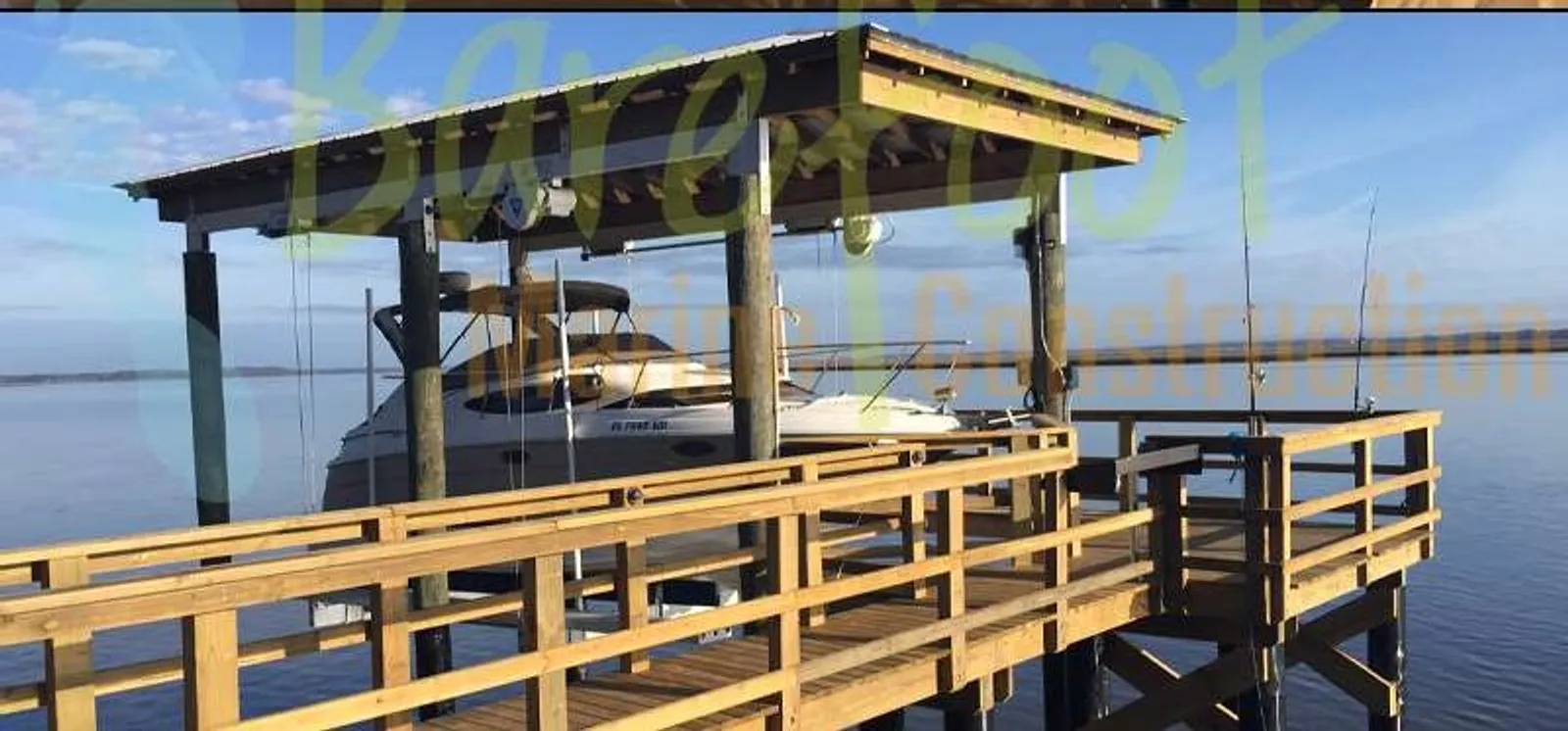
A boathouse is the most structurally demanding thing most waterfront owners will build. It is a large roof, on tall posts, over open water, in a state with a hurricane season — and the whole assembly has to stay put.
We design and build them across Duval, Clay, St. Johns and Nassau counties. If you have an existing boathouse that needs repair, lift work or cable replacement rather than a new structure, that is covered on boat lifts and boathouse service.
What a boathouse actually buys you
Worth being clear about, because it is a significant spend and a boat lift alone already does the most important part.
A lift gets the hull out of the water. That is what stops marine growth and slows corrosion, and it is the single highest-value thing you can do for a vessel kept at a dock.
A boathouse adds protection from everything that comes from above: UV, rain, and in this climate a great deal of both. What that protects is upholstery, canvas, electronics, gelcoat and brightwork — the parts of a boat that sun destroys while the hull is sitting safely in the air.
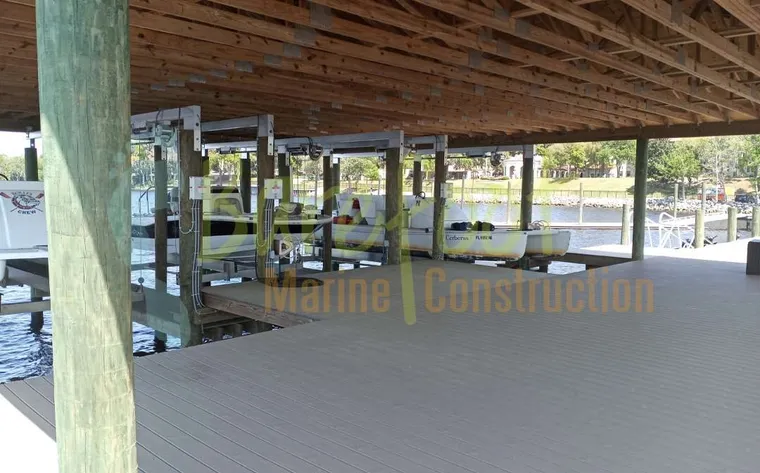
So the question is not really lift or boathouse. It is whether your vessel has enough above the waterline worth protecting to justify the structure. On a heavily finished boat that lives at the dock year-round, it usually does. On a centre console that gets covered anyway, a lift and a good cover may be the better value, and we would rather tell you that.
The structural problem
Uplift, not weight
The intuitive worry about a big roof is that it is heavy. The real problem is the opposite: in a storm the dominant force is uplift, trying to pull the roof off.
That makes the structure a chain, and the chain is only as good as its weakest connection:
- roof covering to purlins or decking
- purlins to rafters or trusses
- rafters to beams
- beams to posts
- posts to piles
- piles into the ground
Every one of those connections has to be rated for the design uplift. Boathouses that fail in storms overwhelmingly fail at a connection — a roof panel, a rafter tie, a post base — not by snapping a beam in half.
Piles carry more than the roof’s weight
The piles have to take the dead load, the uplift, and the lateral load of wind pushing on a large elevated surface. On a new build that is engineered from the start. On a retrofit it is the governing constraint, because an open dock’s piles were sized for an open dock.
Pile size, spacing and penetration come out of that engineering. Penetration in particular is not a place to economise: it is invisible once built and it is what the whole structure is standing on. See pile driving.
Exposure changes the answer
The same boathouse is a different structural problem on sheltered creek frontage than on open water. Fetch, prevailing wind and how much is upwind of you all feed the design. This is one reason we assess the specific property rather than working from a standard detail — conditions across our service areas vary enormously.
Florida’s building code sets wind design requirements, and what applies depends on your location and the structure. We design to what the review requires.
Permitting usually sets the design
Boathouses attract closer review than open docks. Local rules on height, footprint and roof area apply alongside the state and federal marine review, and some waterbodies and jurisdictions restrict covered structures substantially. Requirements vary by site and are revised periodically — confirm current requirements with each reviewing agency before any design work.
On a boathouse this is not paperwork that follows the design. It frequently is the design: how tall, how wide, how much roof, where on the structure, and whether it is permittable at all on your water.
So we establish the envelope first. There is no point drawing something that cannot be approved, and finding that out after you have paid for drawings is an avoidable expense. Permitting services describes how we handle it; dock permits covers which agencies review what.
Design decisions
Vessel dimensions — current and next. Length, beam, and crucially height on the lift, including anything on a T-top or hardtop. Clearance has to work with the boat out of the water, not floating. Designing for the boat you plan to buy is far cheaper than modifying the structure later.
Lift integration. Whether the lift is existing or new, how it is carried, and how the lift structure and the roof structure relate. Cleanest results come from designing both together; see boat lifts.
Open sides, partial walls, or enclosure. Open maximises airflow and minimises wind surface. Walls add weather protection and security, and add surface for wind to work on. Most boathouses here are open-sided for good reason.
Roof covering and pitch. Metal is common and sheds well. Pitch affects both drainage and how wind loads the surface.
Height. Driven by vessel clearance on the lift — and capped by whatever the permit allows, which is often the binding figure.
Decking, walkways and railings around the slip, so the structure is usable rather than just a shelter.
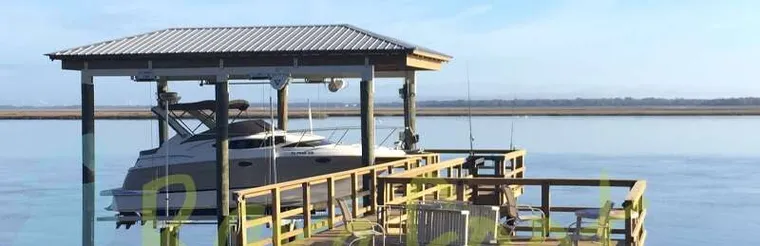
Lighting and power. Much cheaper built in. Electrical work over water carries its own requirements.
Storage. A boathouse tends to accumulate gear whether or not anyone planned for it.
Retrofitting over an existing dock
The first question is the piles, and it is answered by looking rather than assuming. A marine inspection establishes the condition and penetration of what is there before design begins.
Common outcomes:
- Additional or deeper piles within the boathouse footprint — the usual answer.
- Jacketing or restoring existing piles that have a sound core but a deteriorated section, then supplementing them.
- The existing dock will not carry it, and the honest recommendation is to deal with the dock first or build new.
We would rather give you the third answer early than build a boathouse onto a structure that cannot hold it.
Maintenance
A boathouse is a roof in a corrosive environment, and it needs the same attention as the rest of the structure:
- Check connections after every significant storm. Uplift works at fixings whether or not it takes anything.
- Inspect the roof covering and its fixings, not just for leaks.
- Watch post bases and pile tops, where water collects.
- Keep the lift serviced and its cables inspected — cables are a safety item.
- Clear storm debris from the structure; see debris removal.
Dock maintenance covers the walk-round for everything else.
Costs
Footprint, roof type, vessel clearance, how much pile work is needed, whether a lift is included, whether it is new or a retrofit, and access. The dock cost page explains how the number is built up.
Call (904) 327-3931 or request a free estimate. For a retrofit, photographs of the existing piles at low tide, and the dimensions of the boat including its height on the lift, are the two things that move the conversation fastest.
Frequently asked questions
Do I need a permit to build a boathouse?
Is a boathouse worth it compared with a lift alone?
Can a boathouse be built over my existing dock and lift?
What roof should a boathouse have?
Last reviewed October 2026 by Barefoot Marine Construction. Permit requirements and agency rules change — confirm current requirements with the reviewing agency before you plan work.