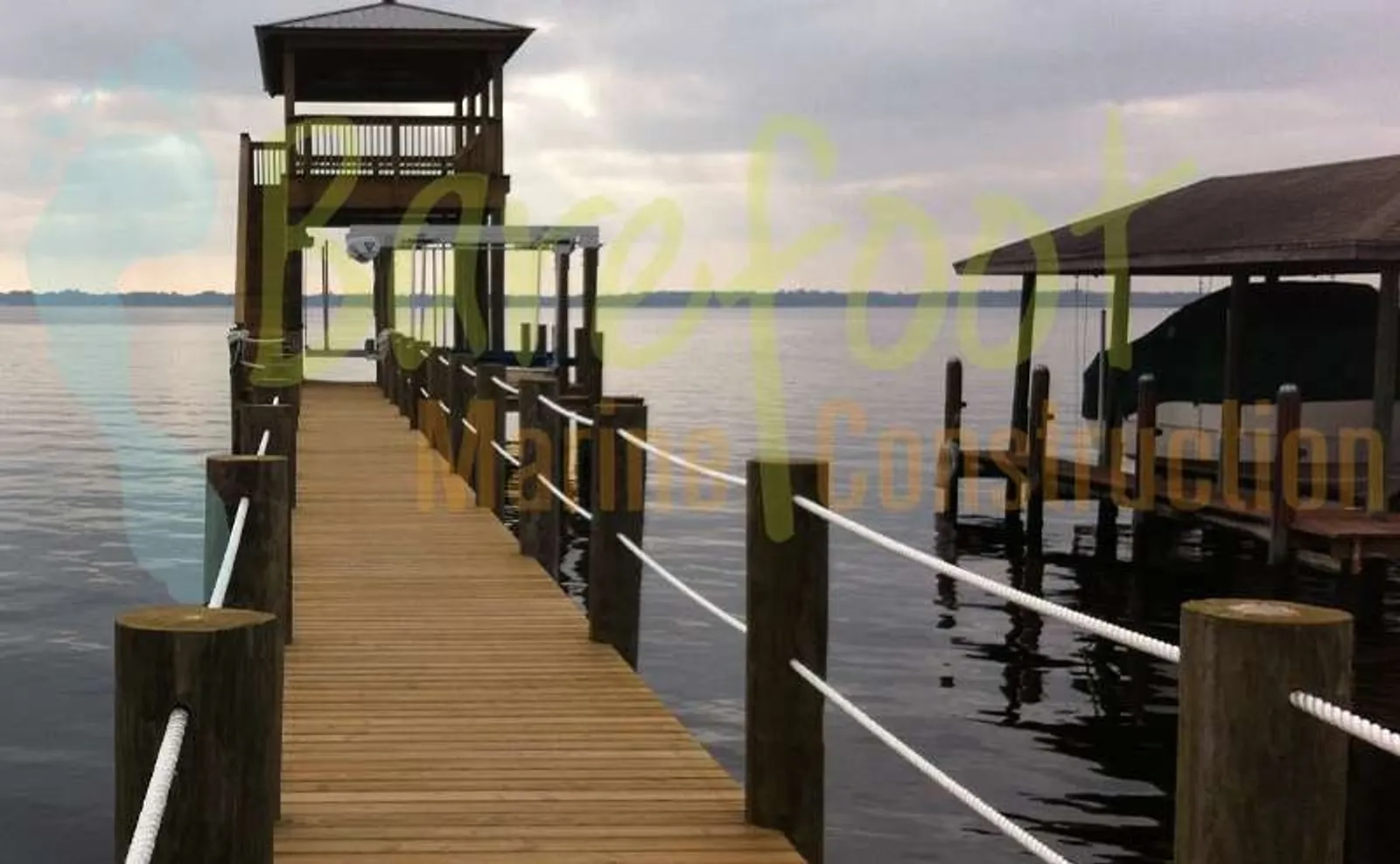
Railings are the most-touched part of a dock and the least-considered part of most dock estimates. They get specified as a line item, fitted at the end, and then they spend the next fifteen years being leaned on, grabbed at, sat on and splashed.
We build them into new docks and decks, and we retrofit them onto existing structures across Duval, Clay, St. Johns and Nassau counties.
Guard, handrail, or neither
These three words get used interchangeably and they are not the same thing, which matters when you are reading a quote or talking to a building department.
A handrail is something to hold. Its job is grip, at a height that suits a hand.
A guard is a barrier. Its job is to stop a person going over the edge, which usually means closely spaced vertical members rather than a couple of horizontals.
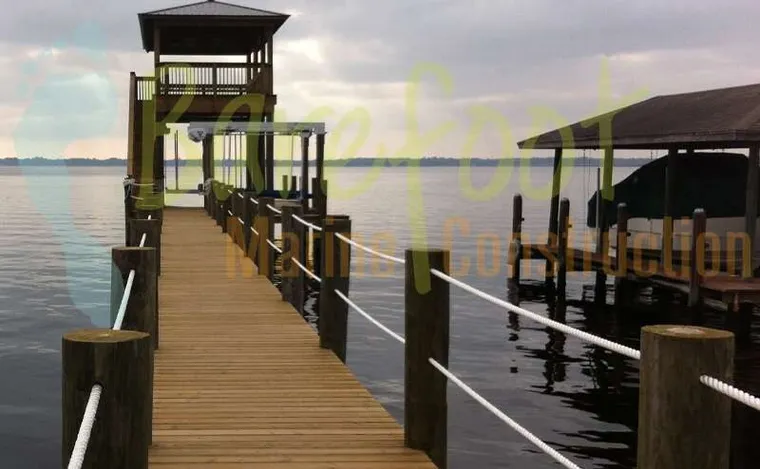
A rail in the loose sense — what most owners mean when they ask for one — is typically a post-and-horizontal arrangement that gives you both a handhold and a visual edge, without being a full guard.
Whether your structure requires a guard, and what it has to look like if it does, depends on how high the walking surface sits above what is below it and on the code your jurisdiction enforces. Those thresholds and requirements are revised periodically and differ between jurisdictions — confirm what applies to your structure with the reviewing building department. What we can do is tell you what we are seeing on your dock and build to what the review requires.
Single rail, double rail, full guard
Single rail. A top rail on posts. A handhold and a defined edge. Cheapest, least obstructive to the view, and adequate on a low dock used by adults who know it.
Double rail. Adds a lower horizontal. This closes the gap a small child can slip through, gives you something to brace a foot or knee against when you are reaching for a line, and makes the structure feel considerably more secure to anyone who is not comfortable over water. If children use the dock, this is usually the right default.
Full guard with balusters or infill. Closely spaced vertical members, or panel infill. This is what a code-required guard generally looks like, and it is also what you fit when you want the structure to be genuinely child-safe rather than child-discouraging. It costs the most and obstructs the view the most, and on a dock with a young family it is frequently the only answer anyone is happy with.
Materials
Treated timber
Matches an existing timber dock, lowest initial cost, and easy to repair a section of. In this climate it needs a maintenance cycle, and in salt water the fasteners are the limiting factor rather than the wood.
Composite
No maintenance cycle to speak of, consistent appearance, and it does not splinter — which is the argument people make for it on a surface children grab. Costs more up front. Still fixed with hardware that has to be specified properly.
Aluminium
Light, will not rot, and powder-coated systems hold up well. The consideration in a marine environment is galvanic corrosion where dissimilar metals meet, so the fixings and any contact with other metals need thinking about rather than assuming.
Cable and wire rope
Keeps the view, which on a waterfront property is frequently the whole point. Cable needs tensioning and periodic attention, and the end fittings and posts take real load — an under-built cable rail sags and looks wrong within a couple of seasons. Note that cable rails have their own treatment under building codes where a guard is required; confirm with the reviewing department before assuming a cable system satisfies it.
Glass and panel systems
Occasionally specified where the view is paramount. In this environment the hardware and the cleaning regime are the practical considerations.
The part that actually fails
In brackish and salt water, railings fail at their connections, not along their length. The post base, the through-bolts, the brackets, the screws into the framing. We see sound timber rails hanging off corroded fixings constantly.
That means two things for anyone pricing a railing job:
- Hardware specification is the decision that matters. Marine-rated fixings cost more, do not show in a finished photograph, and are the difference between a railing that is still solid in fifteen years and one that is loose in five. Ask every bidder what they are using.
- What the posts are fixed to matters as much as the posts. A rail is only as sound as the framing carrying it. On an older dock the deck edge is often the most deteriorated part of the structure, because it takes weather from every direction. This is why a railing enquiry here quite regularly becomes a dock repair conversation first — and we would rather have that conversation than bolt a new rail to framing that will not hold it.
Retrofitting onto an existing dock
Routine, and usually straightforward once we have established what is underneath. What we look at:
- The condition of the framing and decking at the edge, and whether it will take a post load
- Whether blocking or additional framing is needed beneath the deck
- Post spacing for the system you want, which varies between a timber rail and a cable system
- How the rail terminates at the shore end, at steps, and at any gazebo or covered structure
- Whether the dock has other work due that is cheaper to do in the same mobilisation
Building it in from the start
On a new dock or deck, railings are a layout decision rather than a bolt-on. Post positions interact with pile and framing layout, blocking goes in while the frame is open, and you can put structure exactly where the rail needs it instead of working around what is already there.
Two things worth deciding early:
Where the rail stops. A rail that runs the full perimeter is a different structure from one that covers the walkway and leaves the terminal platform open for fishing and boarding. Most people want the second, and realise it at the wrong moment.
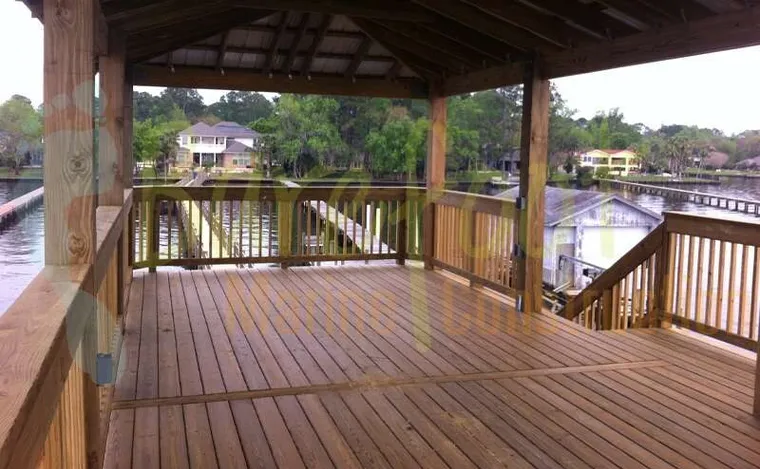
Gates and openings. Where you board, where you step down to a floating section, and whether an opening needs a gate. Children change this answer.
Maintenance
Little, and high-value:
- Check the fixings, not the rail. Rust staining running out of a post base is the early warning.
- Push on it. Any movement that was not there before is a connection letting go.
- Refinish timber on its cycle; tension cable when it needs it.
- Rinse hardware after salt exposure where you reasonably can.
The dock maintenance page covers the rest of the structure on the same walk-round.
Costs
Railings are priced on linear footage, the system chosen, post spacing, and — on a retrofit — whatever framing work turns out to be needed first. The dock cost page covers how dock pricing is built up generally.
Call (904) 327-3931 or request a free estimate. If you are retrofitting, a photo of the deck edge and the underside of the framing tells us most of what we need.
Frequently asked questions
Do I need a handrail on my dock?
What is the difference between a single and a double rail?
Can railings be added to an existing dock?
What railing material lasts longest on the water?
Last reviewed October 2026 by Barefoot Marine Construction. Permit requirements and agency rules change — confirm current requirements with the reviewing agency before you plan work.