Skip to content

Julington Creek · St. Johns County, Florida

Bulkhead Construction in Julington Creek

New bulkheads for Julington Creek property on the Julington Creek — designed around what this shoreline actually does, not around a standard detail.

  • Julington Creek
  • St. Johns River
  • Durbin Creek

Barefoot Marine Construction builds and repairs the structures that hold Julington Creek's waterfront in place. We have worked St. Johns County since 2009 — Certified General Contractor #1533461, carrying Workers' Compensation and USL&H coverage — the federally required cover for maritime work that falls outside state workers' compensation, and the one that actually applies to crews working over water.

This page is about bulkhead construction specifically in Julington Creek, on the Julington Creek. The engineering here is not the same as it is five miles away, and an estimate written without knowing which water your property faces is a guess.

Julington Creek at the water's edge

Before we talk about building a wall here, it is worth being clear about what a Julington Creek bulkhead is actually holding back, and what is working against it.

Julington Creek runs east from the St. Johns River along the Duval–St. Johns boundary, and the communities along it are among the most sheltered waterfront addresses in the region. The creek is a protected, tree-lined waterway, and that shelter is the single most important fact about building anything on it.

Creek frontage with natural banks in many places, often wooded to the water, alongside armoured sections on the more developed lots. Water depth decreases moving east up the creek, which affects both dock design and what vessels can be kept there.

What the water does here

Genuinely low. There is minimal fetch, modest tidal influence this far up the system, and limited boat wake outside of weekends and the areas near the marina. What fails structures here is not wave attack but bank instability, groundwater, and current on the outside of bends.

Fresh to brackish water. Gentler on timber and on steel hardware than the coastal communities, which widens the material options and extends service life for a given specification. Tidal range is modest this far up the system. Deck elevation is simpler to resolve than on the coast, and the twice-daily drawdown that empties soil through wall joints is less aggressive.

Organic-rich creek bank soils over sand, with meaningful variability. The organic content is higher than on the open river, and it is the primary constraint on both wall embedment and pile capacity. For a new bulkhead that drives embedment depth and tieback design directly — the wall has to be founded past anything that will not carry load, and anchored outside the wedge of soil actively pushing on it.

Common shoreline problems in Julington Creek

These are the conditions a new Julington Creek bulkhead has to be designed against. Every one of them is a reason some existing wall on this stretch of Julington Creek, St. Johns River and Durbin Creek is not performing.

  • Bank slumping and undercutting where creek current runs on the outside of bends
  • Erosion where bank vegetation was cleared for views or access
  • Hydrostatic pressure behind walls, which is the dominant failure driver in this low-energy setting
  • Settlement where structures were founded in organics without reaching competent material
  • Tree root intrusion and windthrow disturbing stabilised banks

Building a new bulkhead in Julington Creek

A bulkhead is the structure that holds your ground back from the water. In Julington Creek the soils described above are what it has to be founded in, and they are the reason a wall that works on one lot can be underbuilt on the next.

The quality of the finished wall is mostly decided before anything is driven. We establish the alignment, what the soils will support, what is loading the ground behind the wall, and how equipment is going to reach the work — mainland access is generally good, with the usual constraint of mature trees and landscaping close to the bank. The wooded character that makes these properties attractive also limits how equipment reaches the water.

  • Survey and alignment, including whether building in front of an existing structure is viable
  • Soils and the embedment depth they dictate
  • Exposure assessment for Julington Creek conditions at your specific frontage
  • Surcharge from anything built near the top of the slope — driveway, pool deck, patio or structure
  • Permitting, which usually sets the schedule

How the build runs

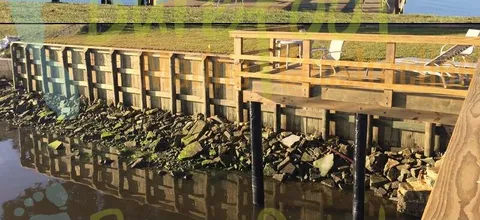
Sheet piles driven to design embedment with interlocks engaged, tiebacks run back to deadman anchors set in undisturbed soil outside the active wedge, a reinforced concrete cap tying the pile tops together, then backfill in compacted lifts with a drainage detail that lets water out without taking soil with it.

That last detail is the one that decides whether you are calling us back in five years. The full construction sequence is here.

Choosing a material for Julington Creek

We build in vinyl, concrete and treated timber, and we have no house favourite. Fresh to brackish water. Gentler on timber and on steel hardware than the coastal communities, which widens the material options and extends service life for a given specification.

For most Julington Creek frontage, vinyl sheet pile properly tied back is the starting point. Concrete becomes worth pricing where there is real surcharge load behind the wall. Timber is a legitimate answer where you are matching an existing structure or the exposure is low.

Seawall concerns in Julington Creek

Whether your wall is really a bulkhead or really a seawall is a design question rather than a naming one, and on this frontage it is worth asking. Julington Creek does not present seawall conditions in any meaningful sense. Full detail: seawall construction in Julington Creek and seawall repair.

Bulkhead and seawall get used interchangeably across Northeast Florida and we answer to both. The distinction that matters is which force governs the design — soil pressure or wave energy. We explain it properly here.

Dock challenges in Julington Creek

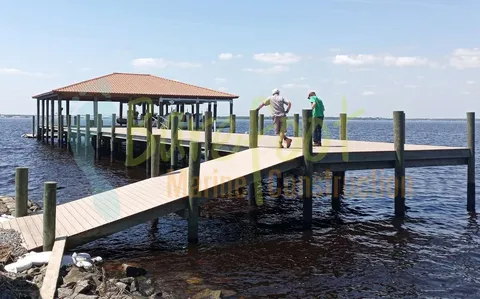
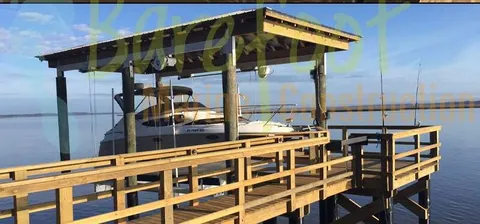
If a dock is going in now or later, say so at design stage — the tie-in and any pile layout are far cheaper to coordinate once. The constraints on this frontage:

More at dock construction in Julington Creek.

  • Shallow water limiting vessel size and requiring longer structures to reach depth
  • Organic bank soils requiring deeper pile penetration than the shelter would suggest
  • Overhanging tree canopy affecting construction access and structure placement

What we would recommend in Julington Creek

Putting that together for a new bulkhead on this frontage:

Creek banks here frequently respond better to a stabilisation approach than to a hard wall — vegetation and soft treatment hold these banks well, cost less, and sit better with the wooded character most owners bought the property for. Where a wall is warranted, lighter is fine; the drainage is where the money should go.

Mainland access is generally good, with the usual constraint of mature trees and landscaping close to the bank. The wooded character that makes these properties attractive also limits how equipment reaches the water.

Permit considerations for bulkhead construction in Julington Creek

New construction is reviewed differently from a repair in place, and a wall on a new alignment differently again. Building waterward of an existing structure — often the cheapest option — has its own permitting consequences.

Creek work brings wetland considerations into review, and the water management district features given the tributary setting. Lower-impact approaches frequently have a smoother path here than hard armouring.

Requirements are revised periodically. Treat this as orientation and confirm current requirements with each reviewing agency before planning work. We handle permitting on the projects we build, and agency review is normally the longest item in the schedule.

Filter the full gallery by neighborhood, county and project type.

View all projects

Barefoot Marine's own job photography from across Northeast Florida.

Julington Creek bulkhead construction questions

How much does a bulkhead cost in Julington Creek?
For a new wall, there is no honest per-foot figure for Julington Creek, because the variables that move the number are site-specific. The ones that matter most here: retained height, the soils (organic-rich creek bank soils over sand, with meaningful variability. The organic content is higher than on the open river, and it is the primary constraint on both wall embedment and pile capacity), whether a driveway, pool deck or structure is adding surcharge behind the wall, and access. Mainland access is generally good, with the usual constraint of mature trees and landscaping close to the bank. The wooded character that makes these properties attractive also limits how equipment reaches the water. Our estimates are free and written against your actual frontage.
How much does a seawall cost in Julington Creek?
More than a bulkhead of the same length, because of toe protection, deeper embedment and a heavier section for wave loading. What drives it in Julington Creek, or the general seawall cost page.
How long do seawalls last in Florida?
There is no single number — drainage, toe protection and tieback corrosion decide it far more than the material does. In Julington Creek, fresher water is materially kinder to hardware and timber than the coastal communities, which extends service life for the same specification. The full answer is here.
Do I need permits for a dock in Julington Creek?
For a new wall, assume yes, and often from more than one agency. Creek work brings wetland considerations into review, and the water management district features given the tributary setting. Lower-impact approaches frequently have a smoother path here than hard armouring. Depending on your site and scope that can involve FDEP, the U.S. Army Corps of Engineers, the St. Johns River Water Management District, and your county or municipal building department. Requirements are revised periodically — confirm current requirements with the reviewing agency. Our dock permits page explains who reviews what, and we handle permitting on the projects we build.
Can a seawall be repaired?
Usually — repair is a fraction of replacement when the piles, embedment and tiebacks are still sound. What that looks like in Julington Creek.
What causes bulkhead failure?
Soil loss through joints, tieback corrosion, toe scour, and chloride attack on the cap — usually several at once. How that plays out in Julington Creek.
What is the best bulkhead material?
There is no best in the abstract — it depends on exposure, soils, what sits behind the wall and how long you plan to own the property. For most Julington Creek frontage, vinyl sheet pile properly tied back is the starting point: it will not rot or corrode, which are the two mechanisms that end walls in this climate. Concrete earns its higher cost where there is real surcharge load behind the wall or the cap is the finished edge. Treated timber is legitimate where you are matching an existing structure, and the fresher water here is kinder to it than on the coast.
What is the best seawall material?
Whatever the material, the section has to suit wave loading and the toe has to be protected — neither concrete nor vinyl resists scour on its own. What suits Julington Creek.

Nearby waterfront communities

We work the whole of this stretch. Conditions change between these communities — sometimes a lot.

Last reviewed November 2026 by Barefoot Marine Construction. Permit requirements and agency rules change — confirm current requirements with the reviewing agency before planning work.

Bulkhead Construction in Julington Creek — free estimate

We work St. Johns County waterfront from our base in Jacksonville. Tell us what you are seeing and we will tell you what it needs.

Certified General Contractor #1533461 · Workers' Comp + USL&H Insured · Serving Northeast Florida since 2009