Skip to content

Camachee Island · St. Johns County, Florida

Seawall Repair in Camachee Island

Diagnosing why a Camachee Island seawall is failing before treating it — because the wrong repair on the right wall still fails.

  • Tolomato River
  • Intracoastal Waterway
  • St. Augustine Inlet

Barefoot Marine Construction builds and repairs the structures that hold Camachee Island's waterfront in place. We have worked St. Johns County since 2009 — Certified General Contractor #1533461, carrying Workers' Compensation and USL&H coverage — the federally required cover for maritime work that falls outside state workers' compensation, and the one that actually applies to crews working over water.

This page is about seawall repair specifically in Camachee Island, on the Tolomato River. The engineering here is not the same as it is five miles away, and an estimate written without knowing which water your property faces is a guess.

Camachee Island at the water's edge

Repairing a seawall without understanding why it failed is how owners end up paying twice. That understanding starts here.

Camachee Island is a compact waterfront community built around Camachee Cove Yacht Harbor, just inside the St. Augustine Inlet on the Tolomato River. It is a boating address first and foremost — the marina is the organising feature, and most properties here were bought with vessel access as the primary consideration.

Frontage is largely hard-edged and purpose-built, oriented around the harbour and the channel serving it. This is one of the more engineered shorelines in the county, with less natural bank and marsh than its neighbours and correspondingly more existing structure to assess and maintain.

What the water does here

The cove itself is relatively protected, which is the point of it. Energy increases sharply towards the Tolomato and the inlet approach, where tidal current becomes a serious consideration. Properties on the outer edge of Camachee face materially different conditions from those tucked inside the harbour.

Full salt exposure. Hardware, fasteners and embedded reinforcement all corrode faster here than on the fresher inland reaches, so specification is a service-life decision rather than a detail. Tidal range is significant. That matters twice over: it drives a large volume of water in and out through any opening in a wall, and it makes a fixed-only dock awkward to board at the bottom of the tide.

Largely made ground and engineered fill associated with the development of the island and harbour, over native sands. Fill character and depth vary, and knowing what is actually under a given property matters more here than in areas with undisturbed native soil. For a repair it narrows down why the wall is failing — walls on this kind of frontage fail differently from walls a few miles away.

Common shoreline problems in Camachee Island

These are the failure patterns along Tolomato River, Intracoastal Waterway and St. Augustine Inlet. Most walls we repair here show more than one, because they feed each other.

  • Toe scour on the outer frontage where inlet-driven current runs hardest
  • Deterioration of ageing harbour-side structures built when the community was developed
  • Soil loss through joints in fill that has limited cohesion to begin with
  • Salt exposure driving corrosion in hardware and reinforcement
  • Concentrated wake and prop wash in the harbour approach

Diagnose before you treat

We get called to a lot of St. Johns County seawalls that have already been repaired once. Usually the work itself was competent. What went wrong was the diagnosis — somebody treated the visible symptom instead of the mechanism producing it.

On Camachee Island frontage, the cove itself is relatively protected, which is the point of it. Energy increases sharply towards the Tolomato and the inlet approach, where tidal current becomes a serious consideration. Properties on the outer edge of Camachee face materially different conditions from those tucked inside the harbour. That shapes which failure mechanism is most likely to be the one actually at work.

The three repairs that save most walls here

Most seawall problems on this shoreline resolve into one of three specialist repairs, and they are frequently used together because they fix different parts of the same failure.

  • Chemical grout injection — polyurethane grout injected through small ports, sealing the path water and soil are moving through. This stops the bleeding.
  • Void filling and soil stabilization — rebuilding and densifying the ground that has already gone, so it can bear load again. This replaces what was lost.
  • Concrete cap and wall repair — spalling, cracking, exposed reinforcement and caps that have separated from the piles. This restores the structure at the top.

What makes Camachee Island walls fail

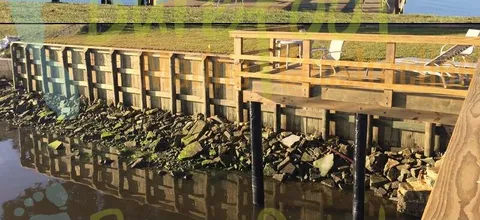
Much of the bulkhead work at Camachee is on structures that have been in place since the community was built, retaining fill rather than native soil. Fill retains less well and leaves more readily through an open joint, so soil loss here can progress faster than on a comparable native-soil property.

The repair that works is the one matched to the mechanism actually at work. On this frontage that most often means establishing whether you are losing soil through the wall, losing embedment beneath it, or losing the cap that ties it together — and those have three different answers.

Where the structural elements are past saving, we will tell you — replacement covers where that line sits, and an inspection is what settles it in writing. On this frontage the deciding evidence is at and below the waterline, which is exactly where a walk along the cap tells you nothing.

Bulkhead concerns in Camachee Island

Walls on this frontage usually have a soil-retention problem running alongside the wave problem. Much of the bulkhead work at Camachee is on structures that have been in place since the community was built, retaining fill rather than native soil. Full detail: bulkhead construction in Camachee Island and bulkhead repair.

Dock challenges in Camachee Island

Seawall repair work frequently reaches the dock tie-in, so it is worth assessing both at once. The constraints on this frontage:

More at dock construction in Camachee Island.

  • Working within an established marina environment with vessel traffic and berthing constraints
  • Strong current on the outer frontage, loading piles and scouring foundations
  • Pile penetration through variable fill to reach competent bearing

What we would recommend in Camachee Island

Putting that together for a seawall that is already failing:

Camachee properties benefit from an inspection that establishes the condition of existing structures and what is under them, since so much of the shoreline is engineered and ageing together. Treatment then differs sharply between inner-harbour and outer-river frontage.

Compact lots in an established marina community, with the practical advantage that water access is excellent and the practical constraint that land access and laydown space are limited. Coordination with harbour operations is usually part of the job.

Permit considerations for seawall repair in Camachee Island

Repairing in place, replacing, and building on a new alignment are three different propositions in review terms. Where your wall sits among them affects both the path and the timeline.

Proximity to the inlet and the ICW channel puts navigation considerations at the front of review, and work within or adjacent to an operating marina brings its own coordination requirements.

Requirements are revised periodically. Treat this as orientation and confirm current requirements with each reviewing agency before planning work. We handle permitting on the projects we build, and agency review is normally the longest item in the schedule.

Filter the full gallery by neighborhood, county and project type.

View all projects

Barefoot Marine's own job photography from across Northeast Florida.

Camachee Island seawall repair questions

How much does a bulkhead cost in Camachee Island?
It depends on retained height, soils, what is loading the ground behind the wall, and how equipment reaches the water — and in Camachee Island, access is a genuine swing factor. Full breakdown for Camachee Island, or the general bulkhead cost page. Estimates are free.
How much does a seawall cost in Camachee Island?
More than a bulkhead of the same length, because of toe protection, deeper embedment and a heavier section for wave loading. What drives it in Camachee Island, or the general seawall cost page.
How long do seawalls last in Florida?
For a wall that needs repairing rather than replacing, the answer is a range rather than a number — two walls built the same week in the same material can be decades apart. What decides it: toe protection and whether scour was allowed for, drainage behind the wall, corrosion protection on the tieback hardware, and whether anyone has looked at it in the last five years. In Camachee Island specifically, full salt exposure accelerates corrosion of hardware and embedded reinforcement, which shortens the clock for any given specification. More on what actually determines it.
Do I need permits for a dock in Camachee Island?
For a wall that needs repairing rather than replacing, assume yes, and often from more than one agency. Proximity to the inlet and the ICW channel puts navigation considerations at the front of review, and work within or adjacent to an operating marina brings its own coordination requirements. Depending on your site and scope that can involve FDEP, the U.S. Army Corps of Engineers, the St. Johns River Water Management District, and your county or municipal building department. Requirements are revised periodically — confirm current requirements with the reviewing agency. Our dock permits page explains who reviews what, and we handle permitting on the projects we build.
Can a seawall be repaired?
For a wall that needs repairing rather than replacing, usually yes — repair is normally a fraction of replacement cost. It makes sense when the structural elements — the piles, their embedment and the tiebacks — are sound enough to build on, and the problem is leakage, soil loss or surface deterioration. It stops making sense when those elements are gone. The deciding evidence is below the waterline, which is why an inspection is worth more than a photograph and a guess. On Camachee Island frontage, walls often stay repairable longer than owners expect, because the energy here is moderate.
What causes bulkhead failure?
Soil loss through joints, tieback corrosion, toe scour, and chloride attack on the cap — usually several at once. How that plays out in Camachee Island.
What is the best bulkhead material?
No single best — for most Camachee Island frontage, tied-back vinyl is the starting point, with concrete where surcharge load is real. Material choice for Camachee Island.
What is the best seawall material?
Whatever the material, the section has to suit wave loading and the toe has to be protected — neither concrete nor vinyl resists scour on its own. What suits Camachee Island.

Nearby waterfront communities

We work the whole of this stretch. Conditions change between these communities — sometimes a lot.

Last reviewed November 2026 by Barefoot Marine Construction. Permit requirements and agency rules change — confirm current requirements with the reviewing agency before planning work.

Seawall Repair in Camachee Island — free estimate

We work St. Johns County waterfront from our base in Jacksonville. Tell us what you are seeing and we will tell you what it needs.

Certified General Contractor #1533461 · Workers' Comp + USL&H Insured · Serving Northeast Florida since 2009