Skip to content

Marsh Landing · St. Johns County, Florida

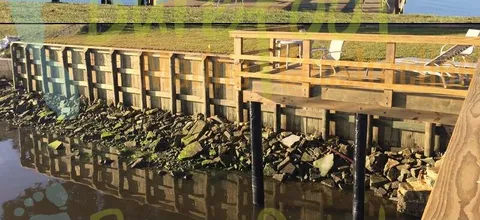
Bulkhead Repair in Marsh Landing

Most failing Marsh Landing bulkheads are losing soil long before they look like they are in trouble. Here is what the symptoms mean on this stretch of water.

  • Intracoastal Waterway
  • tidal marsh creeks

Barefoot Marine Construction builds and repairs the structures that hold Marsh Landing's waterfront in place. We have worked St. Johns County since 2009 — Certified General Contractor #1533461, carrying Workers' Compensation and USL&H coverage — the federally required cover for maritime work that falls outside state workers' compensation, and the one that actually applies to crews working over water.

This page is about bulkhead repair specifically in Marsh Landing, on the Intracoastal Waterway. The engineering here is not the same as it is five miles away, and an estimate written without knowing which water your property faces is a guess.

Marsh Landing at the water's edge

A failing bulkhead is a symptom. Working out what it is a symptom of starts with understanding this particular piece of shoreline.

Marsh Landing is a gated community in Ponte Vedra Beach built around tidal marsh and a marina on the Intracoastal. The name is accurate: a large share of the waterfront here is marsh frontage rather than open water, and that single fact drives most of the marine construction decisions inside the community.

Frontage ranges from direct Intracoastal exposure near the marina to deep marsh frontage where the upland edge sits well back from navigable water. Many properties look out over spartina rather than open water, with a long walkway reaching across the marsh to a terminal platform.

What the water does here

Marsh frontage is low-energy by nature — the grass absorbs wave energy before it reaches the bank, which is exactly what it is for. The energy that matters here is tidal current moving through the creeks, and boat wake on the properties close to the ICW and the marina approach.

Full salt exposure. Hardware, fasteners and embedded reinforcement all corrode faster here than on the fresher inland reaches, so specification is a service-life decision rather than a detail. Tidal range is significant. That matters twice over: it drives a large volume of water in and out through any opening in a wall, and it makes a fixed-only dock awkward to board at the bottom of the tide.

Marsh soils with significant organic content over sand, and considerable variation in depth to competent bearing. This is the governing constraint on pile work inside Marsh Landing: piles frequently have to go well past the organics to find capacity, and that drives both design and cost. For a repair it tells us which failure mechanism is most likely to be the one actually at work, which is the difference between fixing the problem and fixing a symptom.

Common shoreline problems in Marsh Landing

These are the conditions we are actually called out for along Intracoastal Waterway and tidal marsh creeks. If you recognise one of them on your property, it tells us a lot before we arrive.

  • Bank undercutting along tidal creeks where current runs hardest on the outside of bends
  • Loss of marsh fringe where it was cleared or has retreated, removing the buffer that was protecting the bank
  • Settlement of structures founded in organic soils that were not penetrated adequately
  • Soil loss behind older walls on the ICW-facing properties
  • Scour around dock piles where creek current concentrates

Reading the symptoms on a Marsh Landing bulkhead

A bulkhead rarely fails suddenly. It fails quietly for years, and then one day a section of lawn drops and it looks sudden. The most valuable thing you can do on a Marsh Landing property is walk the lawn rather than the wall.

Depressions, soft spots or sinkholes set back from the water mean soil is leaving through the structure. Marsh soils with significant organic content over sand, and considerable variation in depth to competent bearing. This is the governing constraint on pile work inside Marsh Landing: piles frequently have to go well past the organics to find capacity, and that drives both design and cost. That material is going out through the joints, and it is doing it on every tide.

A cap line that is no longer straight points at the tiebacks. Water weeping through joints on a falling tide means the joints are open and carrying fines. Scour at the toe is the one you cannot see from the top, and on this shoreline it matters because marsh frontage is low-energy by nature — the grass absorbs wave energy before it reaches the bank, which is exactly what it is for. The energy that matters here is tidal current moving through the creeks, and boat wake on the properties close to the ICW and the marina approach.

The repairs that fit this shoreline

Which repair is right depends on what is actually failing, which is why we look before we scope. On Marsh Landing frontage the usual candidates are:

Sequence matters more than method

The most common and most expensive mistake we are called to fix is filling voids behind a wall that is still leaking. The new material becomes the next thing the water takes, and the owner pays twice for the same ground. Seal first, fill second.

Where repair is no longer the economical answer, we will say so — replacement covers where that line sits. An inspection is what places your wall on one side of it, and on this shoreline the deciding evidence is below the waterline.

Seawall concerns in Marsh Landing

If the wall is taking wave energy as well as soil pressure, the repair has to account for both. True seawall conditions in Marsh Landing are limited to the properties with direct Intracoastal exposure near the marina approach, where wake is a genuine load. Full detail: seawall construction in Marsh Landing and seawall repair.

Bulkhead and seawall get used interchangeably across Northeast Florida and we answer to both. The distinction that matters is which force governs the design — soil pressure or wave energy. We explain it properly here.

Dock challenges in Marsh Landing

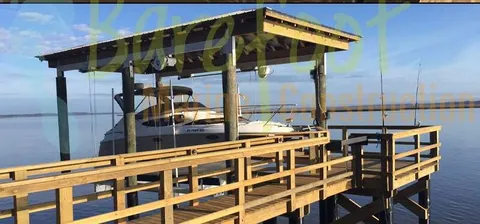
Where a dock ties into a wall that has moved, the dock usually shows it first — a gap or a change in level at the shore end is a useful early signal. The constraints on this frontage:

More at dock construction in Marsh Landing.

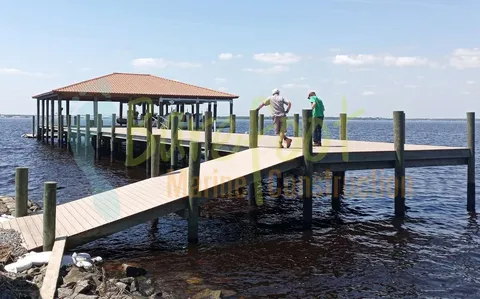
  • Long walkways across marsh to reach navigable depth, which dominates dock cost here
  • Organic soils requiring deeper pile penetration to find bearing
  • Regulated marsh with submerged resources shaping where a structure can go

What we would recommend in Marsh Landing

Putting that together for a repair rather than a rebuild:

Marsh frontage usually points towards a stabilisation approach on the bank plus a properly engineered dock walkway, rather than a hard wall. For the ICW-exposed properties near the marina, a tied-back wall with toe protection is the right answer. The marsh is doing useful work — removing it to install a wall is often a step backwards.

Gated access, mature landscaping and marsh between the upland and the water all constrain how equipment reaches the work. Marsh frontage in particular frequently means working from the water, because there is no way to get a machine across the grass without doing damage that is both expensive and regulated.

Permit considerations for bulkhead repair in Marsh Landing

Repair of an existing permitted structure is generally treated differently from replacement or from building something new, which is one reason establishing the right scope early matters financially as well as structurally.

Marsh is regulated shoreline, and work affecting it is reviewed more closely than work on an already-armoured upland edge. The extent of marsh between your upland and navigable water shapes both what is permittable and how long review takes.

Requirements are revised periodically. Treat this as orientation and confirm current requirements with each reviewing agency before planning work. We handle permitting on the projects we build, and agency review is normally the longest item in the schedule.

Filter the full gallery by neighborhood, county and project type.

View all projects

Barefoot Marine's own job photography from across Northeast Florida.

Marsh Landing bulkhead repair questions

How much does a bulkhead cost in Marsh Landing?
On a wall that is already failing, there is no honest per-foot figure for Marsh Landing, because the variables that move the number are site-specific. The ones that matter most here: retained height, the soils (marsh soils with significant organic content over sand, and considerable variation in depth to competent bearing. This is the governing constraint on pile work inside Marsh Landing: piles frequently have to go well past the organics to find capacity, and that drives both design and cost), whether a driveway, pool deck or structure is adding surcharge behind the wall, and access. Gated access, mature landscaping and marsh between the upland and the water all constrain how equipment reaches the work. Marsh frontage in particular frequently means working from the water, because there is no way to get a machine across the grass without doing damage that is both expensive and regulated. Our estimates are free and written against your actual frontage.
How much does a seawall cost in Marsh Landing?
More than a bulkhead of the same length, because of toe protection, deeper embedment and a heavier section for wave loading. What drives it in Marsh Landing, or the general seawall cost page.
How long do seawalls last in Florida?
There is no single number — drainage, toe protection and tieback corrosion decide it far more than the material does. In Marsh Landing, full salt exposure accelerates corrosion of hardware and embedded reinforcement, which shortens the clock for any given specification. The full answer is here.
Do I need permits for a dock in Marsh Landing?
Yes, and usually from several agencies at once. Marsh is regulated shoreline, and work affecting it is reviewed more closely than work on an already-armoured upland edge. Dock permitting in Marsh Landing, or who reviews what. Confirm current requirements with the reviewing agency.
Can a seawall be repaired?
On a wall that is already failing, usually yes — repair is normally a fraction of replacement cost. It makes sense when the structural elements — the piles, their embedment and the tiebacks — are sound enough to build on, and the problem is leakage, soil loss or surface deterioration. It stops making sense when those elements are gone. The deciding evidence is below the waterline, which is why an inspection is worth more than a photograph and a guess. On Marsh Landing frontage, walls often stay repairable longer than owners expect, because the energy here is moderate.
What causes bulkhead failure?
Four things, and they feed each other. Soil loss through joints — water moving in and out carries fines with it, which is what produces the depressions in a lawn. Tieback failure — the anchors hold the top of the wall, and when the hardware corrodes the wall leans. Toe scour — the wall quietly loses the embedment it depends on. Cap deterioration — chlorides reach the reinforcement, the steel corrodes and expands, and the concrete breaks apart from the inside. In Marsh Landing, marsh frontage is low-energy by nature — the grass absorbs wave energy before it reaches the bank, which is exactly what it is for. The energy that matters here is tidal current moving through the creeks, and boat wake on the properties close to the ICW and the marina approach.
What is the best bulkhead material?
No single best — for most Marsh Landing frontage, tied-back vinyl is the starting point, with concrete where surcharge load is real. Material choice for Marsh Landing.
What is the best seawall material?
Whatever the material, the section has to suit wave loading and the toe has to be protected — neither concrete nor vinyl resists scour on its own. What suits Marsh Landing.

Nearby waterfront communities

We work the whole of this stretch. Conditions change between these communities — sometimes a lot.

Last reviewed November 2026 by Barefoot Marine Construction. Permit requirements and agency rules change — confirm current requirements with the reviewing agency before planning work.

Bulkhead Repair in Marsh Landing — free estimate

We work St. Johns County waterfront from our base in Jacksonville. Tell us what you are seeing and we will tell you what it needs.

Certified General Contractor #1533461 · Workers' Comp + USL&H Insured · Serving Northeast Florida since 2009