Skip to content

Davis Shores · St. Johns County, Florida

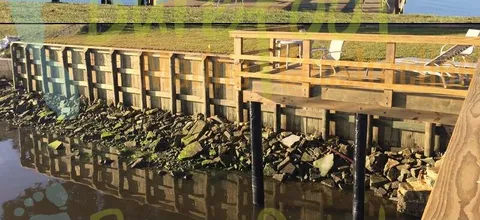
Seawall Construction in Davis Shores

Seawalls built for the energy of Davis Shores's frontage on the Matanzas River.

  • Matanzas River
  • Salt Run
  • Intracoastal Waterway

Barefoot Marine Construction builds and repairs the structures that hold Davis Shores's waterfront in place. We have worked St. Johns County since 2009 — Certified General Contractor #1533461, carrying Workers' Compensation and USL&H coverage — the federally required cover for maritime work that falls outside state workers' compensation, and the one that actually applies to crews working over water.

This page is about seawall construction specifically in Davis Shores, on the Matanzas River. The engineering here is not the same as it is five miles away, and an estimate written without knowing which water your property faces is a guess.

Davis Shores at the water's edge

A seawall is designed around the energy it absorbs, so the design starts with the water rather than with the wall.

Davis Shores sits at the north end of Anastasia Island, immediately across the Bridge of Lions from downtown St. Augustine. It is a low-lying, densely built waterfront neighbourhood on filled ground, with frontage on both the Matanzas River and Salt Run, and it has a long and well-documented relationship with high water.

Almost entirely armoured, with seawalls and bulkheads along most of the developed frontage. Low elevation relative to the water is the defining characteristic — the margin between a normal high tide and the top of many walls here is slim, and that shapes everything about how structures perform.

What the water does here

Tidal current through the Matanzas and Salt Run, boat wake from a busy stretch of the ICW, and — the dominant concern — storm surge and elevated water levels. Davis Shores is low enough that overtopping is a design case rather than a remote possibility.

Full salt exposure. Hardware, fasteners and embedded reinforcement all corrode faster here than on the fresher inland reaches, so specification is a service-life decision rather than a detail. Tidal range is significant. That matters twice over: it drives a large volume of water in and out through any opening in a wall, and it makes a fixed-only dock awkward to board at the bottom of the tide.

Filled ground over original marsh and river bottom. The organic layers beneath the fill are a central engineering fact here: they provide little resistance, and embedment has to reach past them. Settlement over time is common on properties where it did not. For a seawall it drives section selection, how much toe protection the wall needs, and where the cap has to sit to limit overtopping.

Common shoreline problems in Davis Shores

A new seawall on Matanzas River, Salt Run and Intracoastal Waterway has to answer all of these. The ones involving scour and overtopping are the ones most often left out of a cheap design.

  • Overtopping during elevated water events, eroding soil from behind walls on the landward side
  • Soil loss through wall joints into water that is moving on every tide
  • Settlement of fill over organic layers, showing as depressions and tilting hardscape
  • Toe scour where current runs along the frontage
  • Hydrostatic pressure behind walls where drainage cannot keep up during high water

Designing a seawall for Davis Shores conditions

A seawall is designed around the energy it has to absorb, and that is why we will not quote one by the foot over the phone. Tidal current through the Matanzas and Salt Run, boat wake from a busy stretch of the ICW, and — the dominant concern — storm surge and elevated water levels. Davis Shores is low enough that overtopping is a design case rather than a remote possibility.

On Davis Shores frontage that drives four things: the section selected, how deep it is embedded, whether toe protection is needed and how much, and where the top of the wall sits relative to design water levels.

  • Fetch and wake exposure specific to your frontage on the Matanzas River
  • Embedment depth, with an allowance for scour rather than for soil load alone
  • Toe protection sized for the energy the wall will reflect back into the water
  • Cap elevation and freeboard, set to limit overtopping
  • Tieback spacing and anchor placement outside the active soil wedge

Toe protection is the detail that decides it

A vertical wall reflects wave energy downward into the water at its own base, and that reflected energy excavates the material the wall is embedded in. The wall undermines its own foundation, continuously, and none of it is visible from the top.

This is a neighbourhood where cap elevation and freeboard genuinely matter. A seawall here that is only designed for the water in front of it, without regard to what happens when water comes over it, is solving half the problem. Walls in Davis Shores should be assessed with overtopping explicitly in mind.

If you are comparing estimates for Davis Shores and one of them has no toe protection on exposed frontage, that is the question to ask before you compare the totals.

Materials for this water

Full salt exposure. Hardware, fasteners and embedded reinforcement all corrode faster here than on the fresher inland reaches, so specification is a service-life decision rather than a detail. We build vinyl and concrete seawalls, and the choice turns on exposure, what sits behind the wall, and how long you intend to own the property.

The important qualifier for vinyl is that wave loading is a larger demand than soil retention, so the section has to be selected for it. A profile adequate on sheltered water is not automatically adequate here. The full construction process is here.

Bulkhead concerns in Davis Shores

A new seawall here is also a soil-retaining structure, so the bulkhead side of the problem does not go away. Davis Shores bulkheads are retaining fill on low ground against water that regularly comes close to the top of the wall. Full detail: bulkhead construction in Davis Shores and bulkhead repair.

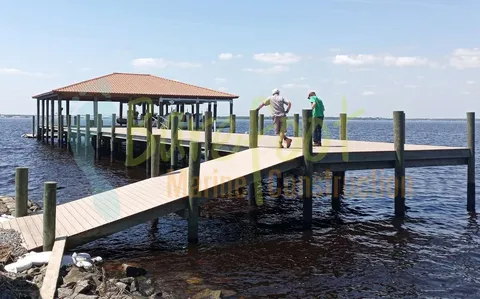
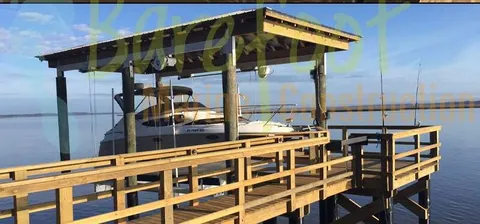
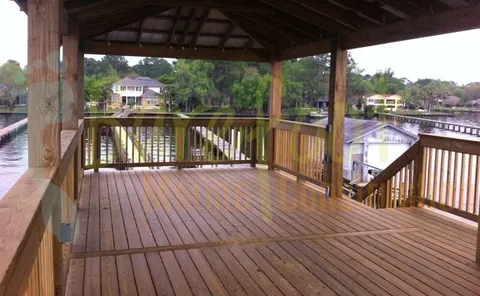
Dock challenges in Davis Shores

A new wall is the natural moment to resolve a dock tie-in properly rather than working around it. The constraints on this frontage:

More at dock construction in Davis Shores.

  • Significant tidal range in a neighbourhood with low freeboard to begin with
  • Tidal current in Salt Run and the Matanzas loading piles and scouring foundations
  • Dense development limiting the space available for structures and for construction access

What we would recommend in Davis Shores

Putting that together for a new seawall here:

Davis Shores properties warrant attention to the drainage and the ground behind the wall as much as to the wall itself. Void filling and grout injection are frequently the highest-value work here, because soil loss into fill over organics compounds quickly and the symptoms show up in hardscape before anyone looks at the wall.

Land access is generally workable, but lots are compact and densely developed, with limited laydown space and hardscape close to the water. Protecting and restoring what is in the work corridor is a real part of the scope.

Permit considerations for seawall construction in Davis Shores

A new seawall is reviewed as new construction, and the toe protection it needs is part of the proposal rather than an afterthought added later.

Low elevation and proximity to a historic district bring considerations beyond the ordinary marine review path, and work on the Matanzas and the ICW carries navigation review. Local requirements here are worth confirming early.

Requirements are revised periodically. Treat this as orientation and confirm current requirements with each reviewing agency before planning work. We handle permitting on the projects we build, and agency review is normally the longest item in the schedule.

Filter the full gallery by neighborhood, county and project type.

View all projects

Barefoot Marine's own job photography from across Northeast Florida.

Davis Shores seawall construction questions

How much does a bulkhead cost in Davis Shores?
It depends on retained height, soils, what is loading the ground behind the wall, and how equipment reaches the water — and in Davis Shores, access is a genuine swing factor. Full breakdown for Davis Shores, or the general bulkhead cost page. Estimates are free.
How much does a seawall cost in Davis Shores?
Designing a new seawall, a seawall generally costs more than a bulkhead of the same length on the same site, because it carries work the bulkhead does not: toe protection sized for the exposure, deeper embedment with a scour allowance, and a heavier section for wave loading. On Davis Shores frontage, moderate exposure — not extreme, but persistent enough to matter over a structure’s life, which is what drives that difference. Demolition of an existing wall and permitting are the other two line items worth stated explicitly rather than discovered later.
How long do seawalls last in Florida?
Designing a new seawall, the answer is a range rather than a number — two walls built the same week in the same material can be decades apart. What decides it: toe protection and whether scour was allowed for, drainage behind the wall, corrosion protection on the tieback hardware, and whether anyone has looked at it in the last five years. In Davis Shores specifically, full salt exposure accelerates corrosion of hardware and embedded reinforcement, which shortens the clock for any given specification. More on what actually determines it.
Do I need permits for a dock in Davis Shores?
Yes, and usually from several agencies at once. Low elevation and proximity to a historic district bring considerations beyond the ordinary marine review path, and work on the Matanzas and the ICW carries navigation review. Dock permitting in Davis Shores, or who reviews what. Confirm current requirements with the reviewing agency.
Can a seawall be repaired?
Usually — repair is a fraction of replacement when the piles, embedment and tiebacks are still sound. What that looks like in Davis Shores.
What causes bulkhead failure?
Soil loss through joints, tieback corrosion, toe scour, and chloride attack on the cap — usually several at once. How that plays out in Davis Shores.
What is the best bulkhead material?
No single best — for most Davis Shores frontage, tied-back vinyl is the starting point, with concrete where surcharge load is real. Material choice for Davis Shores.
What is the best seawall material?
The same honest answer, with one addition specific to seawalls: whatever material you choose, the section has to be selected for wave loading rather than for soil retention, and the toe has to be protected. Davis Shores frontage sees moderate but persistent energy, so this matters over the life of the wall rather than on any single day. Concrete brings mass and stiffness; vinyl cannot corrode. Neither protects against scour on its own.

Nearby waterfront communities

We work the whole of this stretch. Conditions change between these communities — sometimes a lot.

Last reviewed November 2026 by Barefoot Marine Construction. Permit requirements and agency rules change — confirm current requirements with the reviewing agency before planning work.

Seawall Construction in Davis Shores — free estimate

We work St. Johns County waterfront from our base in Jacksonville. Tell us what you are seeing and we will tell you what it needs.

Certified General Contractor #1533461 · Workers' Comp + USL&H Insured · Serving Northeast Florida since 2009